Our second Sustainability Report
This report contains information about our principles, our mission statement and our approach to sustainability and discusses 2019 achievements and developments.
Our goal is to get better every day – especially when it comes to sustainability. However, significant changes can only be achieved with the help of our employees and stakeholders. Mutual trust is crucial here and requires, in particular, information and transparency – something which HS Timber Group aims to provide with this Sustainability Report as well.
2.1. GRI Standards
The content, information and figures are selected and presented in compliance with the standards of the Global Reporting Initiative (GRI Standards). GRI, the international stakeholder initiative, has developed accepted guidelines for sustainability reporting that ensure transparency and comparability. This report meets the requirements of the “Core option”. GRI indicators discussed in the report are presented in chapter 10. A review of the Sustainability Report was performed by Umweltbundesamt GmbH.
2.2. Report boundary
The content and Key Performance Indicators (KPIs) presented relate to the year 2019. The main subject of the report is the timberprocessing arm of HS Timber Group. Changes in the delimitation of data, or KPIs, for example when the entire Group is considered, are indicated at the appropriate point, especially when it comes to the energy production facilities. Besides this Sustainability Report, HS Timber Group also provides information about its corporate responsibility on its website www.hs.at.
2.3. Our sustainability process
The relevant fields of action of HS Timber Group in the area of sustainability are shown in the materiality matrix. Based on our mission statement, this is regularly updated in a multi-stage process. In December 2019, a total of 78 stakeholders took part in an online survey to evaluate the current activities of HS Timber Group and to identify important topics in the field of sustainability. To complete the survey, several personal interviews were conducted, with selected stakeholders that included customers, business partners and suppliers, NGOs, interest groups and representatives from political and (regional) administration.
In the next step, based on the results of the stakeholder survey, the relevant topics were discussed and prioritised, together with managers and different company experts. Special attention was paid to the environmental and social impact of the company’s activities, in each field of action. This led to the revision of the materiality matrix that provides the basis for the contents of this report, the GRI topics and indicators described and the sustainability program for the coming years.
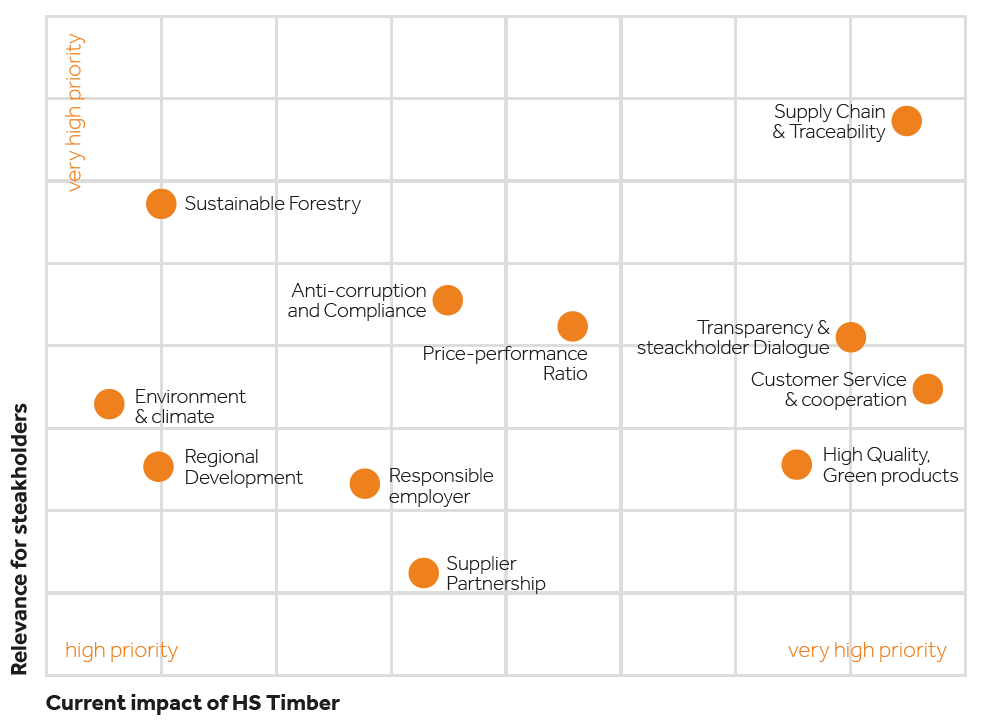
The materiality matrix shows - for each topic covered - on the one hand, the importance for the stakeholders (vertical axis) and, on the other hand, the extent of the impact in environmental and social dimensions (horizontal axis). In short: how important is the topic from the perspective of the stakeholders? And where does HS Timber Group have a major impact in terms of environmental protection or social development? The more relevant an issue is in relation to these two factors, the more sustainability management must focus on it, taking into account economic impacts. Based on the materiality matrix, 11 topics were defined as significant for HS Timber Group. On the following pages, you will find out more about these issues, especially about our approach, our objectives and specific measures.
We have exercised great care in collecting the data and other information contained in this report. However, the possibility of errors cannot be ruled out completely. Statements about future developments are based on information and forecasts available to us at the time this report was published. The latter have also been meticulously recorded. Nevertheless, multiple factors and developments may result in variations. We therefore apologise for the fact that we can give no guarantee that the data or other information contained in this report is correct. This report is based on the publisher’s current business policy, which is subject to change. No claims or other rights of any kind against companies of the publisher or their board members or employees may be derived from or in connection with this report. Any liability of these companies, board members and employees arising from or in connection with this report shall be excluded.