
Environmental protection and climate change
Environmental protection and climate change are among the biggest challenges of our time. At the United Nations Climate Change Conference held in Paris in December 2015, 195 nations signed a worldwide agreement on climate change for the first time. This aims to limit the global average temperature rise to well below 2°C, in order to mitigate climate change. All countries, regions, companies and individuals are asked to make a contribution within the scope of their capabilities. The fight against climate change is essential for our future.
As a wood processing company, HS Timber Group has a head start when it comes to tackling climate change: wood is a renewable raw material that extracts CO2 from the atmosphere. It is crucial that the forest from which the wood is harvested is managed sustainably. Only intact forest ecosystems can rejuvenate and thus close the natural CO2 cycle. For this reason, HS Timber places strong emphasis on a sustainable and secure wood supply chain.
The technology used in our sawmills ensures 100% utilisation of the logs delivered. By-products such as sawdust, wood chips and wood shavings are processed into pellets and briquettes for green energy production or are processed further into pulp, paper or particle boards.
7.1. Environmental performance
The first step involved certification of the Reci sawmill site to the international ISO 14001 standard in 2018. It is planned that the system will be rolled out across the entire Group. We are striving for certification of all sites by 2022 at the latest.
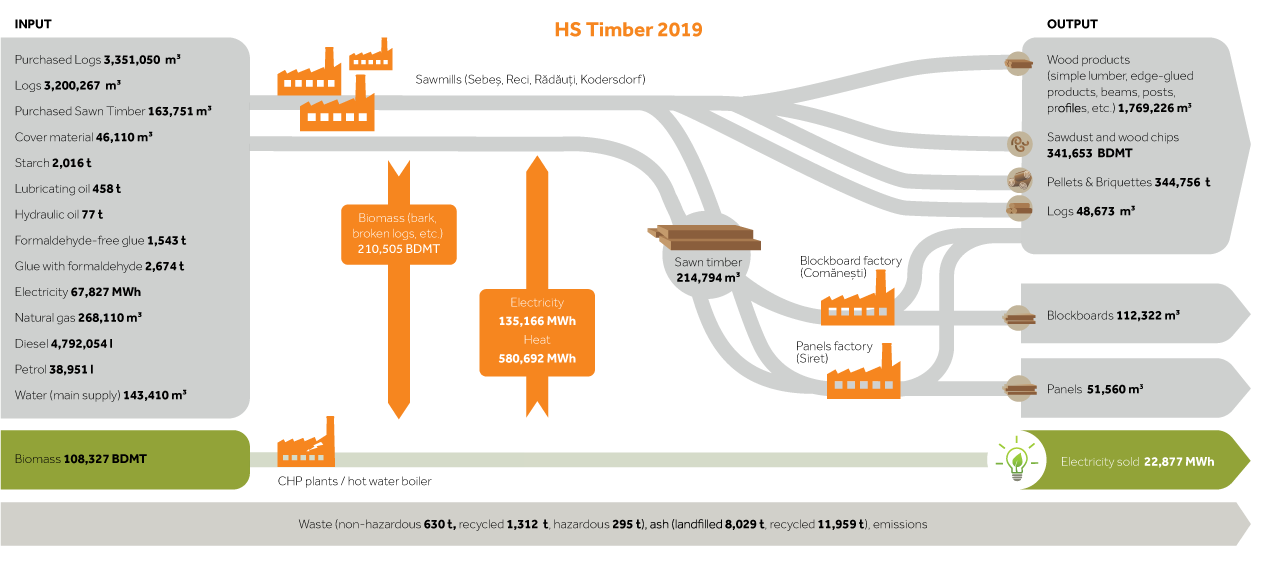
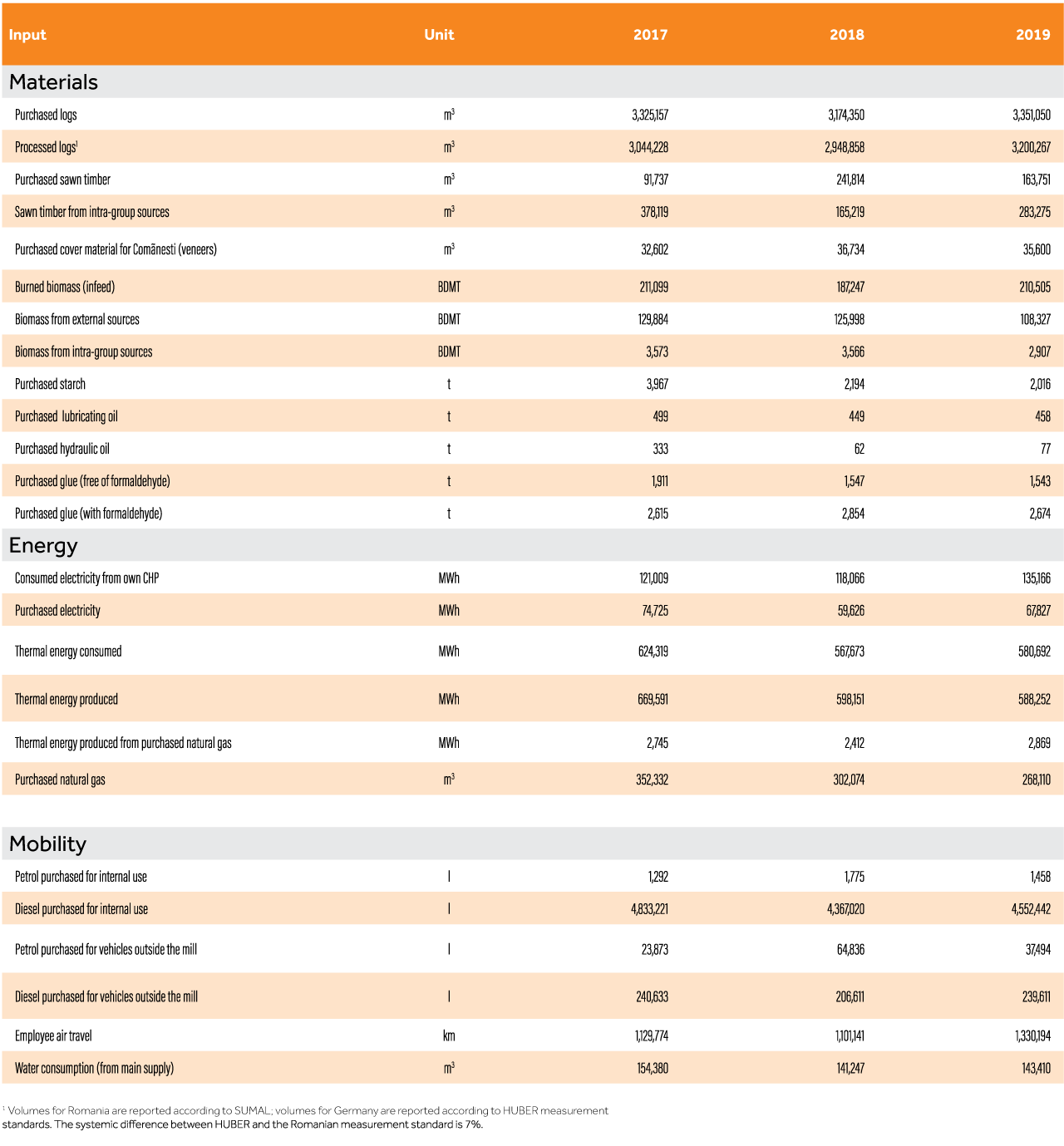
As an international production company, HS Timber Group uses large quantities of energy and resources. In 2019, approximately 3.35 million solid m3 of logs passed through the gates of HS Timber Group’s plants. Around 203 GWh of electricity and 580 GWh of heat were needed to produce the high-quality wood products. This energy is mainly generated by means of combined heat and power (CHP) in the stateof-the-art biomass power plants at the sawmills in Romania. These plants primarily use by-products and waste products from production (e.g. bark) or other biomass products, for generation purposes. Some of the Group’s energy production facilities are part of another Group entity (Bio Electrica Transilvania SRL).
Only around 36% of the company’s total electricity requirements are purchased externally. Most of this is destined for factories that do not have electrical power plants of their own (Kodersdorf*, Comănești, Siret). In 2019, HS Timber Group’s self-sufficiency rate with green electricity therefore stood at 64%.
The company consumes 99% of the thermal energy it produces from renewable raw materials.
HS Timber Group has set itself ambitious goals, especially in relation to climate change and energy efficiency. By 2025, we intend to lower company-wide GHG emissions by 25% per produced unit and reduce our energy consumption per produced unit also by 30%. Thus, our aim is to be a role model in the wood processing industry and make a significant contribution to tackling climate change. These goals have been enshrined in our current environmental policy.
Since these goals were established, a set of measures was implemented along with a monitoring system. Also, we are in the process of reshaping our action plan in order to make sure we make progress towards these targets. One of the next steps consists of a benchmarking exercise regarding our environmental performance.
In 2019, capital expenditures for the reduction of electricity consumption were on the level of roughly 1 million Euro.
7.2. Focus on energy efficiency
Efficient use of energy and resources is primordial for HS Timber Group’s production chain. We aim at using only state-of- the-art machines and vehicles at our plants. This guarantees compliance with high environmental standards and low emissions.
Our capacity management ensures that devices, machines or lighting that are not in use are switched off for the duration. A lot of energy can also be lost if the extensive compressed air system at the plants leaks – even in the case of a minor leak. Here, too, clear internal processes ensure regular controls and rapid resolution of the issue.
The lighting at all plants is continuously updated to the state-of–the-art. Currently, we are progressively replacing conventional lights with LED lights, which brings significant energy reductions, especially on our outdoor light pillars.
7.3. Mobility
The vehicles used by HS Timber consumed approximately 4.75 million litres of diesel and 36,800 litres of petrol in 2019. Most of the fuel (95%) is consumed on the factory premises, mainly for logistics purposes, in the large log and sawn timber yards at the sawmills7.
Fuel consumption and emissions are important criteria when purchasing new vehicles. HS Timber Group only buys vehicles that are rated “best in class” in these categories. In order to further reduce fuel consumption, regular fuel-saving driver training is also provided at all plants.
Using the vehicle data in connection with GPS Timber and Abisol5, vehicle-specific fuel consumption is analysed and optimised with a focus on the vehicle drivers. Avoiding empty runs, or wasted trips, prevent unnecessary fuel consumption.
In the future, electric vehicles will be increasingly used for secondary processing (indoors). We are also taking steps to reduce our oil consumption. At the logyard, we partially use biodegradable lubricants. Through the replacement of conventional oils in vehicles with special long-life oils, the oil change intervals have been extended many times over. Not only does this reduce oil consumption, but it also reduces the cost of disposing of waste oil. Disposal is performed exclusively by state-accredited companies.
7 The vehicle fleet includes a variety of forklifts, excavators, logs and containers handling machinery.
8 Technologies for improving logistics at the logyards and on the sites.
7.4. Exhaust gas purification
At HS Timber Group, direct air emissions are primarily caused by the exhaust gases from biomass power plants and gas boilers, as well as internal combustion engines of vehicles. These are mainly carbon dioxide (CO2), nitrogen oxides (NOx), dust and fine dust.
With regard to its biomass CHP units – which generate both green electricity and heat – the company relies on state-of-the-art technology and exhaust gas purification systems to minimise air pollutants. Effective control of the multi-stage combustion process not only maximises energy conversion, but also reduces carbon monoxide (CO) and NOx emissions. Dust emissions are almost completely eliminated by means of an electrostatic precipitator.
In Reci, a selective non-catalytic reduction (SNCR) system is also used. The technology is based on the reduction of NOx to nitrogen through a reaction with urea at high temperature. This reduces the NOx concentration in the exhaust air.
A continuous emissions monitoring system monitors the relevant emissions of the CHP units. Emission monitoring is carried out annually by an accredited laboratory, to ensure that the air quality complies with European and national environmental legislation.
7.5. Greenhouse gas balance
The greenhouse gas balance covers all of the company’s principal sites and activities in Romania, Germany and Austria (production sites in Reci, Rădăuți, Sebeș and Comănești in Romania and Kodersdorf in Germany; the head offices in Vienna and Bucharest are also included). The emission sources included are differentiated according to the three scopes of the Greenhouse Gas Protocol.
Greenhouse gas emissions from purchased electricity (57%), the company’s diesel fleet (28%) and biomass combustion (12%) make up 97% of the balance. Further GHG missions arose from purchased natural gas, the petrol and propane fleet, and air travel.
The emission factors for direct emissions from electricity reported under Scope 2 are taken from IEA (2019), CO2 Emissions from Fuel Combustion. These conversion factors include the greenhouse gases CO2, CH4 and N2O.
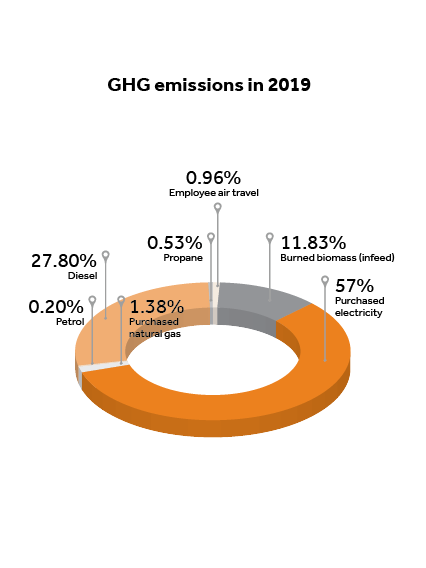
HS Timber Group’s Greenhouse Gas Balance
Carbon emissions of the HS Timber Group in 2019
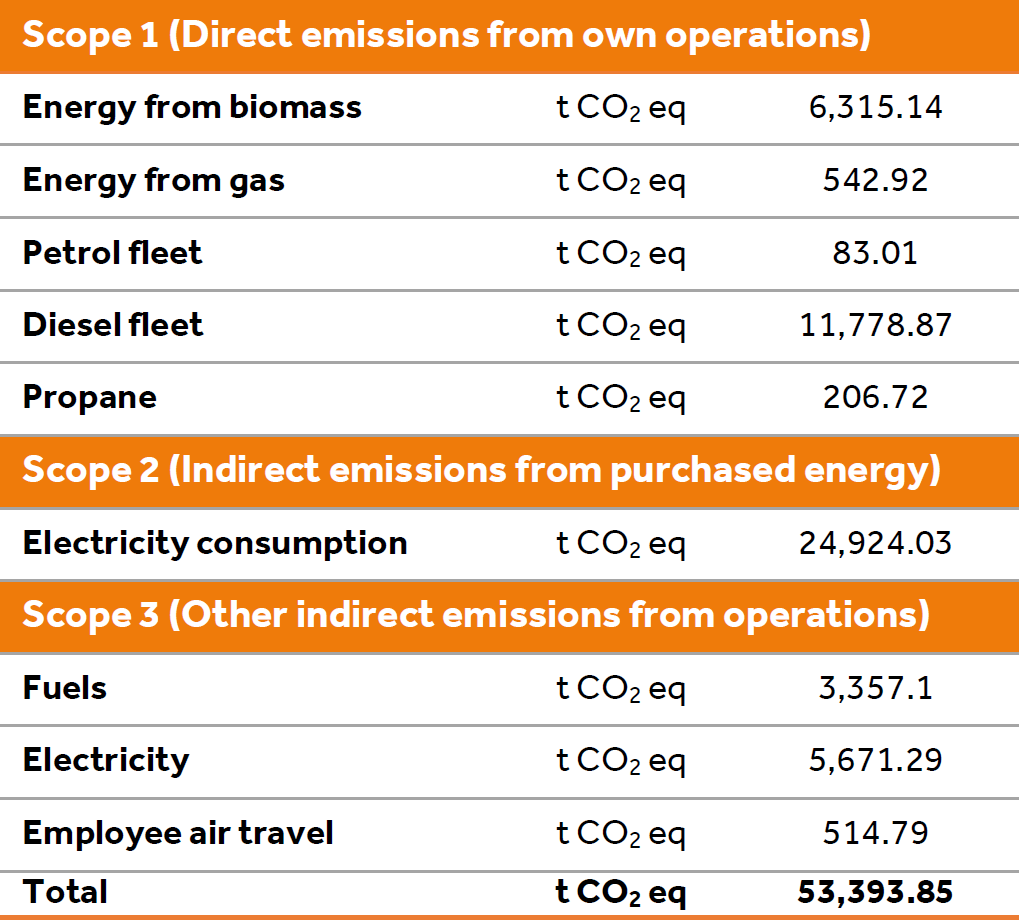
(Source of emission factors: IEA, UBA 2020, Ecoinvent 3.6 Länderdaten)
7.6. Reuse and recycling
While our most important raw material – wood – is utilised 100%, different types of waste are generated during production. These are professionally separated and reused or recycled where possible.
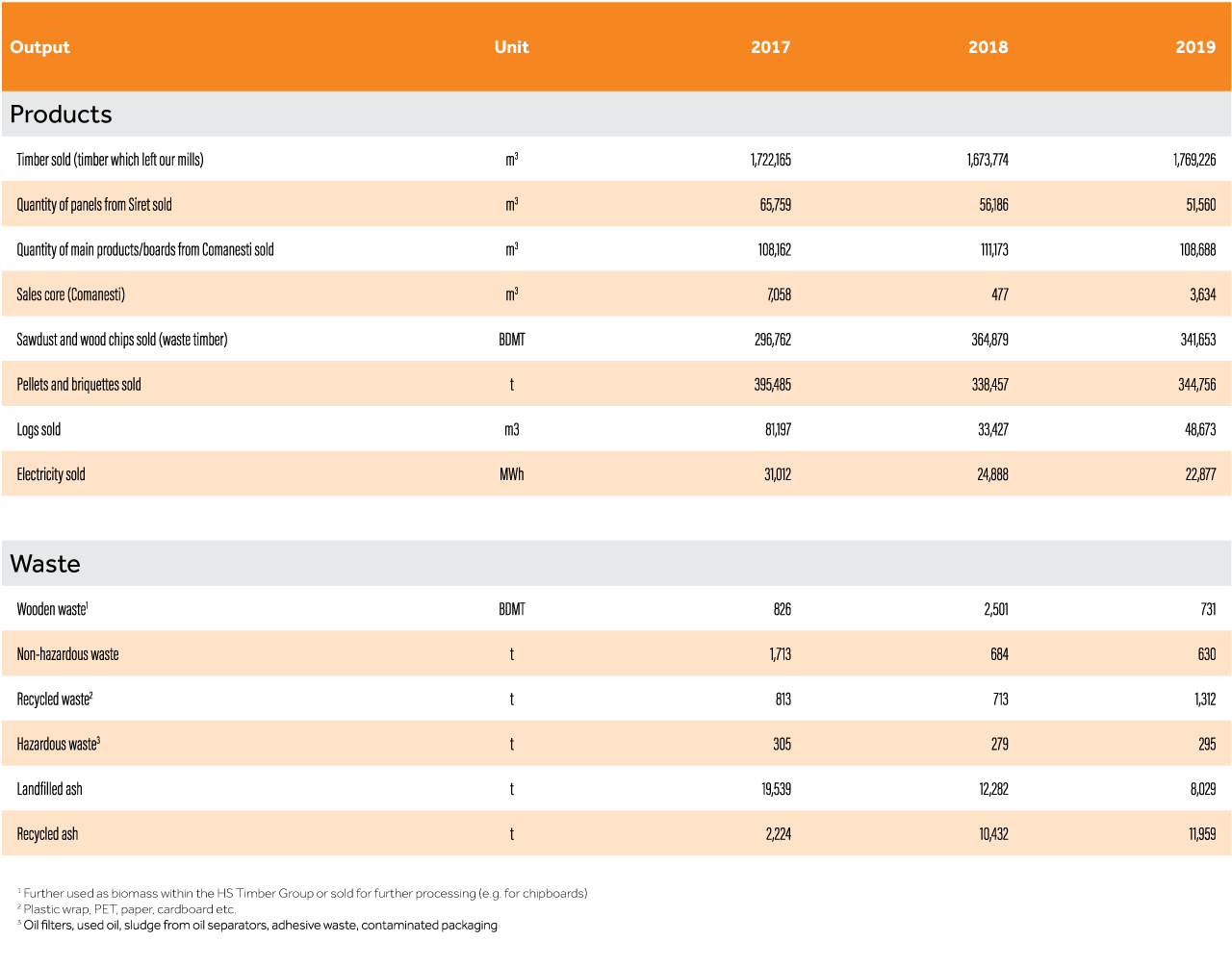
In 2019, 630 tonnes of non-hazardous and 295 tonnes of hazardous waste (such as waste oils) were generated, in addition to wood ash, which produced the largest quantities of waste. All waste is disposed of professionally by the appropriate companies. In particular, we ensure that hazardous waste is disposed of safely at suitable facilities, as stipulated by contract.
Our biomass power plants produce large quantities of ash as a product of combustion – 22,700 tonnes in 2019. A large volume of this ash is currently still deposited in landfills, but 60% is already recycled. Further applications for the reuse of this ash are constantly explored.
7.7. Water and wastewater management
In the state-of-the-art CHP units, water is used in the steam cycle to operate the turbine. Only a small quantity of fresh water needs to be fed back into the system.
Wastewater management aims to ensure that no contaminated wastewater can enter water bodies or receiving water. If necessary, wastewater is pre-treated by an oil separator system and either treated in the company’s own sewage treatment plants or discharged into the public sewer system, where it is then treated in the local water treatment plant. It goes without saying that the wastewater quality is regularly monitored by accredited laboratories. This way, we ensure that our wastewater is environmentally safe and meets all legal requirements.
We have exercised great care in collecting the data and other information contained in this report. However, the possibility of errors cannot be ruled out completely. Statements about future developments are based on information and forecasts available to us at the time this report was published. The latter have also been meticulously recorded. Nevertheless, multiple factors and developments may result in variations. We therefore apologise for the fact that we can give no guarantee that the data or other information contained in this report is correct. This report is based on the publisher’s current business policy, which is subject to change. No claims or other rights of any kind against companies of the publisher or their board members or employees may be derived from or in connection with this report. Any liability of these companies, board members and employees arising from or in connection with this report shall be excluded.