Sustainable supply chain
At HS Timber Group, a sustainable supply chain means honesty, long-term partnerships and rigorous controls. Wood is a unique, versatile raw material and, at the same time, a renewable resource. As trees grow, wood absorbs the carbon dioxide (CO2) responsible for climate change. Through its activities, the company has been closely associated with this valuable material for generations.
Then, as now, the availability of high-quality wood is essential. Only a forest that is managed sustainably can meet industry demand and also supply future generations. Preserving and fostering this natural resource is one of our uppermost concerns. This is why we rely on sophisticated supplier management and rigorous Due Diligence. We only purchase coniferous wood from verified, non-controversial sources. In addition, we undergo regular voluntary checks by international expert organisations. We insist on careful use of environmental resources and effective environmental management as integral parts of our economic activity. This fosters innovation and success while ensuring the protection of forests.
In 2019, HS Timber Group purchased approximately 3.35 million m3 of sawlogs and around 163,700 m3 of sawn timber to manufacture high-quality wood products. This was coniferous wood from spruce, fir or pine trees. We use hardwood only in very small quantities for blockboard production, e.g. veneers.
We have a diverse supplier structure. In 2019, the three sawmills in Romania purchased wood from 679 merchants and forestry companies. Around 47% of these vendors are small businesses that supply no more than 500 m3 of logs per year. We have been in partnership with 178 suppliers for at least nine years (suppliers that made deliveries each year in 2011-2019).
The Group’s strict purchasing policy applies to all wood suppliers, from international timber merchants to forestry professionals. However, the large number of suppliers also makes one thing clear: only a far-reaching, effective Due Diligence system, using cutting-edge technology, can ensure a sustainable supply chain.
5.1. Timber sourcing policy
Sustainably managed forests have the highest priority for HS Timber Group. We are committed to ensuring that all our timber is responsibly sourced, from sustainably managed forests. We will purchase timber only from non-controversial sources and in full compliance with our timber sourcing policy. We require all suppliers and vendors to demonstrate compliance with all legal requirements for forest management, timber harvesting and related trade, as a basis for long-term partnership.
We operate a robust security system. As a responsible business, we verify the origin of the timber we use, in order to exclude controversial sources. We are explicitly committed to excluding material sourced from virgin forests and nonintervention areas, as well as material originating from forest land whose ownership title is effectively disputed in court and when courts or authorities have ordered the suspension of operations. Moreover, we voluntarily refrain from buying material originating from National Parks in Romania.
We do business only with partners whom we have reason to trust as acting with Due Diligence and professional prudence. Where executive managers or staff in similar functions have been convicted by a final binding court decision for illegal wood harvesting or corruption, we will, as a rule, exclude their companies from our supply chain for three years. In severe and justified cases, we reserve the right to delist suppliers at any time appropriate. To re-enter the supply chain thereafter requires a comprehensive audit demonstrating full compliance with all requirements of this timber sourcing policy.
We believe forest certification to be an instrument that helps to promote sustainable forest management. We encourage our suppliers to seek certification for sustainable forest management and chain-of-custody, and we want to take this path collectively. Our target is to source 100% wood from certified forests by 2025.
We invite stakeholders to an open and constructive dialogue to help us continuously improve our business and our performance in regard to a responsible wood industry. The Timber Sourcing Policy is reviewed and a public statement on its implementation is issued annually (Supply Chain Report).
The document is available at https://hs.at/en/responsibility/what-we-do/timber-sourcing-policy.html
5.2. Our Due Diligence system in Romania
In 2019, HS Timber Group’s sawmills in Romania purchased around 50% of their sawlogs from the domestic market. There, they operate in a challenging business environment. In the past, the media reported on irregularities in the Romanian supply chain, one of the main criticisms being that HS Timber Group relied excessively on document control and failed to communicate adequately with stakeholders. We acknowledged this weakness and introduced a targeted comprehensive range of measures – the action plan for a sustainable and secure word supply chain in Romania. This plan, which is unique in Europe, by far surpasses the strict legal requirements in Romania.
To ensure that the softwood we purchase comes from sustainable forestry, we implemented an innovative supplier management system and improved our Due Diligence system. In addition to rigorous controls and high standards, cooperation and the development of long-term partnerships, especially with our suppliers and customers, are paramount. Our goal is to do everything in our power to fight illegal logging from the starting point of the supply chain.
We audit each new supplier to ensure compliance with our timber sourcing policy. We run an annual on site audit programme in which suppliers are audited on a random basis. If suppliers deliver via collection points, they undergo at least one annual audit, larger suppliers more regularly
After all these direct checks of suppliers, the wood delivered undergoes careful controls with respect to quality and origin. Every truck delivering logs is screened at the gates of our sawmills on the basis of the freight papers and database queries. If we encounter illegalities in the supply chain, we take immediate action and contact the authorities. We do not do business with suppliers convicted of illegal logging or corruption.
The GPS-based wood tracking system Timflow shows the origin of each truckload3. This is something that is unique in the European timber industry. All data on all Romanian truck deliveries is available to the general public at www.timflow.com. An electronic 3D measurement system also ensures that the delivery volume stated in the consignment note is not exceeded. This impedes “laundering” of illegal surpluses.
5.2.1. Thorough check of all suppliers
Our suppliers are contractually required to design the supply chain in a transparent and traceable manner. Prior to conclusion of a new timber delivery contract or renewal of an existing one, suppliers receive a questionnaire, known as the supplier declaration. This enables us to collect information about the company, the origin of the wood sold and the supply chain. HS Timber Group performs a risk analysis based on the data collected. If we discover that certain requirements are not met, or the origin of the deliveries cannot be clearly traced, we take further steps, such as carrying out onsite inspections. We suspend the business relationship until the inconsistencies have been cleared up. The results of ongoing media coverage are also factored into the risk assessment on a country-specific basis.
In addition to direct contact with the suppliers, HS Timber Group engages in regular dialogue with stakeholders. This takes place on multiple levels so as to receive input from all sides and identify grievances at an early stage. The channels for stakeholder communication include biannual public consultations, direct correspondence and regular meetings, as well as targeted discussions with NGOs, relevant market participants, municipalities and authorities and other interested stakeholders.
5.2.2. Hundreds of site inspections
Our control and Due Diligence system is based on much more than just documents. It requires an audit for each new supplier. Suppliers with logyards have an increased risk along the supply chain and are therefore also audited on site, annually. Due to the large number of suppliers (we purchased wood from 679 merchants and forestry companies in Romania in 2019), this means hundreds of inspections each quarter. We focus on the local forestry companies in order to get a picture of where the wood delivered actually comes from. Site visits are, of course, carried out in all risk countries from which we source wood.
Suppliers with logyards have an increased risk along the supply chain and are therefore also audited on site, annually.
Audits are performed with the iAuditor application with elaborate pre-defined checklists. The application runs on a tablet which also registers the GPS coordinates of the audit location and a time stamp of the audit.
In Romania alone, we conducted 487 Chain of Custody audits, 32 Forest Management Unit audits and 90 harvesting plot audits.
5.2.3. External reviews by experts
Since the EUTR entered into force in 2013, HS Timber Group’s Due Diligence system has been audited by the competent authorities a total of 19 times. All official EUTR audits to date have confirmed the observance of statutory duties of care (Due Diligence) and took place without any objections.
A recent expert opinion issued by the independent consulting firm SGS, consulted by HS to benchmark especially the supplier countries of Ukraine and Belarus, confirms conformity of HS Timber Group’s security system to EUTR requirements for these countries. The report acknowledged especially the strength of the system, when the company relies on its own specialists, rather than third party assessments. In the past, independent expert organisations, such as INDUFOR from Finland and KPMG Canada, also carefully examined the company’s security systems, confirming the efficiency of the steps taken and helping to advance a continuous improvement process at the same time.
“The Lacey Act is a 1900 United States law that bans trafficking in illegal wildlife. In 2008, the Act was amended to include plants and plant products such as timber and paper. This landmark legislation is the world’s first ban on trade in illegally sourced wood products. There are two major components to the plant amendments: a ban on trading plants or plant products harvested in violation of the law; and a requirement to declare the scientific name, value, quantity, and country of harvest origin for some products.
The Lacey Act is a fact-based statute with strict liability, which means that only actual legality counts (no third-party certification or verification schemes can be used to ’prove‘ legality under the Act) and that violators of the law can face criminal and civil sanctions, even if they did not know that they were dealing with an illegally-harvested product.”3
Companies are required to run a so-called “due care” system, which is similar to the Due Diligence concept in European Union’s legislation or certification systems. In any of these systems, companies are required to mitigate risks of potential controversial inflow, down to negligible levels and to do everything possible to determine that products are legal. In 2017, the company cooperated with the renowned US-based law firm Quinn Emanuel to assess and improve its security architecture concerning supply chain issues. All recommendations were implemented at that point. Although HS is not an importer on the US market, the company sees this exercise as a very important measure to help US customers comply with the Lacey Act’s requirements.
Addtionally, in 2019, the company was subject of 4 extensive external on-site audits by customers which were successfully completed.
4 https://forestlegality.org/policy/us-lacey-act (3.4.2020)
5.2.4. Programme for the Endorsement of Forest Certification − PEFC™
 HS HS Timber Group holds the PEFC Chain of Custody single site certificates for all its production facilities. A PEFC CoC certificate safeguards the integrity of the supply chain, from forest to product. The certification from this internationally-recognised organisation demonstrates that HS Timber Group purchases and processes wood from certified, controlled, undisputed sources. In order to ensure this consistently, the company is audited externally once per year. For certification to be successful, all stages of the value chain must follow these rules, from the forest to the sawmill and all the way to the final product. Concerning legality, all certified material undergoes the same security measures as non-certified material.
5.2.5. Forest Stewardship Council® – FSC®
 The FSC (Forest Stewardship Council) was established in 1993 as a result of the Rio de Janeiro Environmental Summit. The FSC is a nongovernmental, non-profit organisation committed to the environmentally sound, socially responsible and economically viable use of the world’s forests.
FSC and HS Timber Group are in an ongoing dialogue process, where the company shall demonstrate tangible and significant improvements in its timber trade operations, as required by FSC, to be eligible to regain FSC certification in the future.
FSC told the company that it “acknowledges commitment shown by HS in acting on the conditions. At this moment, FSC is reviewing its dispute management system, which means some fundamental support processes need to be in place before FSC can take HS further. FSC looks forward to working with HS to end disassociation.”5
5 More information is available in our first sustainability report, page 32, https://bit.ly/2AlgxLn
5.2.6. Action plan for a sustainable and secure wood supply chain in Romania
The company continuously evaluates its environmental standards and actions and develops methods for improvement. The measures HS Timber Group has implemented in Romania by far surpass the legal requirements there. Since 2017, the company has invested more than one million Euro in its Action Plan for a Sustainable and Secure Wood Supply Chain in Romania. This plan consists of many measures that together build a strong and state-of-the-art security architecture, which, to the best extent possible, excludes the inflow of controversial material, strengthens the reliability of the supply chain and supports sustainable forest management in Romania. The action plan includes measures such as a strong and up to date Due Diligence System – the GPS tracking System Timflow being part of it – but also actions like the Zero Timber from National Parks Policy, which intends to voluntarily support efforts to have a better protection of National Parks in Romania. Transparency and openness are not just catchphrases for the company; they became part of the company’s profile and are extensively applied throughout the operations, especially when it comes to sustainable sourcing of wood. An overview of all actions implemented can be found at https://hs.at/en/responsibility/a-responsible-supply-chain/measures-of-the-action-plan.html.
5.2.7. GPS tracking for complete transparency in the supply chain
As a private company, we cannot and do not wish to assume any government’s function, but we will do everything in our power within our sphere of influence to support the fight against illegal logging. The core measure is the publicly accessible GPS system Timflow, which was developed and implemented by HS Timber Group, together with a Romanian mobile network operator.
Timflow allows us to track the precise origins of the roundwood that trucks deliver to the sawmills. It consists of: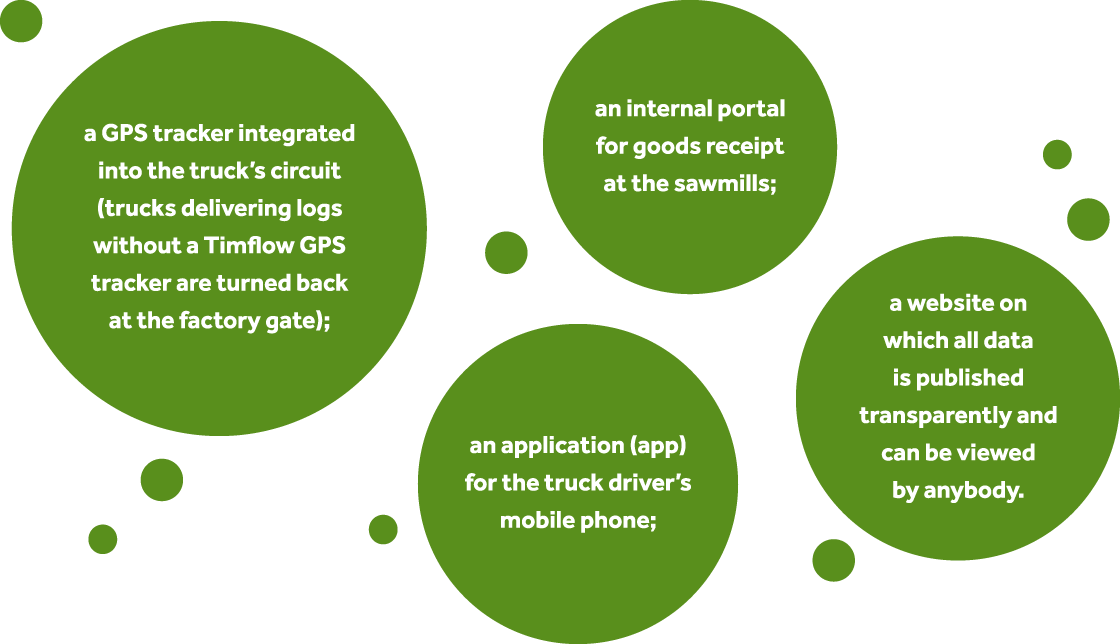
Timflow video
https://youtu.be/409TD4OCZIo
The procedure is simple. After the truck is loaded, the load is registered with the mobile Timflow application, photographed, and the data uploaded to the cloud server. During the trip to the sawmill, the GPS tracker sends the truck’s position to the same server. When the truck arrives at the mill, the digital data can then be used to check whether the truck’s origin matches the transport documents, whether the truck took a comprehensible route and (based on the photographs) whether the load that arrived is the same as the one that left the forest.
HS Timber Group publishes all Timflow data transparently on www.timflow.com. Interested parties can study the origin and the photos of all loads and request additional information. We published data on over 28,000 consignments in 2019. The Timflow system has been continuously updated and improved – for example by adding an automatic check as to whether trucks come from exclusion zones (forests and National Parks that are World Heritage sites) or from potential tracts of virgin forest4. Timflow is also attracting attention internationally and was presented to an international audience at the FOR-MEC Forest Symposium in Brașov (Romania) in September 2017 and at the PEFC™ Stakeholder Dialogue in Helsinki in November 2017.
In 2020, it is planned to offer Timflow also to logyard suppliers in order to enable them to trace their input as well.
6 I.-A. Biris & P. Veen, 2005. Inventory and strategy for sustainable management and protection of virgin forests in Romania, 61 pp.
5.2.8. Code of Conduct for employees and suppliers
Promoting ethical conduct among employees and business partners is particularly important in a challenging business environment. After rolling out a Code of Conduct for its employees two years ago, HS Timber Group introduced a Code of Conduct for suppliers in 2019, as a reference system for ethical business conduct along the supply chain. Encouraging our suppliers to follow this path together with us is one of the goals of HS Timber Group’s mission statement. All log purchasing agreements reference this Supplier Code of Conduct.
The Code of Conduct is not just a set of rules, but also a guide for employees that should give advice on how to deal with critical situations. Violations of the Code of Conduct are dealt with in accordance with the specifications of the compliance management system. A case management system that collects internal and external input enables the head of the company’s Supply Chain Control & Certification Department and the Compliance Office to deal with and document violations in a structured manner. In addition, provisions in the Code of Conduct are incorporated into an internal audit program.
5.2.9. Tracking of individual logs
Our GPS system Timflow tracks every truck that delivers roundwood to the sawmills. Even more precise, however, would be the tracking of every single log from harvesting to processing. This development direction prompted HS Timber to launch a pilot project in 2017, to examine the possibility of implementing a system for tracking individual trunks. Due to the large number of tree trunks processed (in Romania alone, it is estimated that over 100 million are processed each year), identification of a single tree trunk is a major challenge. The system must be scalable, cost-effective, robust and transparent.
A pilot project called Timflow ID was launched early 2019, to increase security in the supply chain. Timflow ID is a new system for timber tracking through wood collection points. It is based on a traceability system for each log and consists of the following elements:

The system was tested with two suppliers in the second quarter of 2019, to determine its practical applicability. The experience gained from a previous project provided the basis for this project. The project was successful, we were able to ensure full traceability of the logs during the testing period, but there are still further developments to be considered in order to become cost-effective.
5.2.10. No wood from National Parks
Romanian legislation allows for logging in so-called national park buffer zones and in the case of sanitary cuttings. Nevertheless, HS Timber Group voluntarily introduced a strict purchasing principle at the beginning of 2015: Zero wood from National Parks in Romania.
To ensure compliance with this principle, we stipulate in purchase agreements that no wood from Romanian National Parks will be accepted. Consequently, every wood consignment arriving at HS Timber Group sawmills in Romania is checked for these aspects. This is performed using the GPS tracking system Timflow, through on-site visits and audits of suppliers, as well as based on the legally required documentation of origin.
In December 2019, one of our Supply Chain Control Officers at the Sebes mill identified a transport from Vâlcea county as originating in the Cozia National Park. The transport was put “under investigation” and unloaded at the designated area inside the mill. After further checks, the origin from the national park was confirmed and the transport was rejected. The reason for this was an error on the supplier’s part, who didn’t comply with HS’s policy regarding National Parks.
5.2.11. Sourcing from Ukraine
In 2015, log exports were banned in Ukraine for ten years. This ban was extended to pine saw logs in 2017. HS Timber Group therefore purchases sawn timber from Ukraine and the suppliers are large and medium-sized sawmills, as well as small, family-owned rural sawmills. The sawn wood input from Ukraine was roughly 90,000 m3 in 2019. Approximately 60% of the purchased wood is certified, and the rest of the input comes mostly from certified forests with a broken Chain of Custody.
Ukraine has been in a controversial political and economic situation for more than a decade. The country is in a difficult financial situation, with significant loans and problems of state budget. Under these circumstances, the Ukrainian forestry and wood industry has been subject to several allegations regarding a significant level of corruption and an improper forest governance performance, especially in the field of sanitary fellings.
A part of HS Timber Group’s risk mitigation policy is to fully exclude areas with uncertain governance (conflict timber). Risks regarding high biodiversity value are considered and most of the input comes from low biodiversity value (e.g. plantation) forests.
High risk areas and controversial sources (conflict timber) are excluded. Auditing activities in 2018 covered all non-certified suppliers and FMUs and the auditing program in 2019 also integrated all certified sawmills.
In order to mitigate the risk in the Ukrainian supply chain, HS Timber Group’s verification and risk mitigation programme includes:
- Employment of local staff responsible for supply chain control;
- Regular training of staff on supply chain control and compliance issues;
- Legal check of all suppliers (bi-annually);
- Forest checks and plot visits;
- Chain of Custody (CoC) verification audits (100% coverage);
- Use of iAuditor for all types of audits;
- Checking the obligatory roundwood tag codes at publicly available state homepage part of the auditing procedure;
- Media monitoring and stakeholder communication;
- Due Diligence system checks by third parties.
- HS Due Dilligence system does have the same level of assurance for certified and non certified forests.
5.2.12. Our Due Diligence system in detail
HS Timber Group’s Due Diligence system was designed and implemented to mitigate the risk of having raw material from uncontrolled or controversial sources in its supply chain, as well as to meet the requirements of the different governmental regulations (e.g. EUTR or Lacey Act) and certification schemes. It also covers our commitment not to accept wood from National Parks (even in cases where this has been legally harvested).
Gathering information – supplier declaration
Before HS Timber Group enters into a contract with a wood supplier, it requires the latter to submit a “supplier declaration”. The supplier declaration explicitly specifies the Forest Management Units (in low-risk countries we ask that only the country of origin be declared, whereas in high-risk countries we map the entire supply chain and reach the FMU level) or other intermediaries from which the wood is sourced. The supplier declaration gives HS Timber Group the right to conduct supplier audits, and with it the supplier confirms that the origin of the wood is known, it is legal and its traceability is documented. If the origin of wood changes, the supplier declaration is updated.
Risk management
Where the risk assessment indicates a low risk, a desk audit is performed, which entails a document review. This covers material originating from certified forests and material coming directly from the forest to the mills, in those cases when the Forest Management Unit has already been audited.
For cases where the wood supplied has been identified as “high risk”, based on its origin, or on the supply chain, HS Timber Group has defined a number of different control measures to mitigate the risk and allow the material to be delivered to the mills as “controlled material”.
On-site auditing of suppliers and forests
The on-site audit is designed to obtain more detailed information about the supply chain and the risk of mixing wood from different sources. It is one of HS Timber Group’s most important risk mitigation measures. Its purpose is also to check the plausibility of the data provided on the supplier declaration , to verify the legality of required documents and to get a picture of the supplier’s operations. It reveals whether there is any controversial activity on the part of the supplier. In the case of highrisk countries, the on-site audit extends to the level of Forest Management Units (exceptions are only possible if the supplying forest holds a valid forest certificate) prior to delivery. All supplying Forest Management Units (FMUs) are included in an annual audit program; in highrisk countries, a sample of FMUs from the total number of FMUs needs to be chosen and audited. Our Supply Chain Control staff checks, for example, management plans and compliance with harvesting permits issued. These checks also cover health and safety of the staff, as well as other issues related to proper forest management.
Timflow wood tracking
While a Due Diligence system requirement is to perform an initial check of suppliers and sampling of deliveries, HS Timber Group’s Due Diligence system investigates in detail all incoming deliveries in high-risk countries, with a special focus on Romanian supplies.
In Romania, HS Timber Group tracks the transport routes of log trucks using GPS technology. Delivery by truck is the main transport method for wood sourced in Romania. The system was introduced for all log deliveries by truck in Romania. We know exactly where the logs were loaded and what the truck load looked like at origin and we check the route of the truck to the mill. All system entries are timestamped. Not all deliveries come directly from the forest; they also come from local logyards. With Timflow, we have the certainty that the material comes from legally authorised logyards, which are strictly regulated in Romania. In cases where irregularities are identified after the material’s arrival at the mill, this material is stored separately in a designated area and labelled “under investigation”.
The material can only be used for production if the case is clarified by the local Supply Chain Control Officer. Based on the written self-declaration, the officer asks the supplier to provide additional legal documentation on the delivery, which allows the organisation to either classify the material supplied as of negligible risk, or conduct a third-party supplier audit. Deliveries which obviously infringe legal and internal requirements are immediately rejected at the mill gate (e.g. deficient documents, no Timflow system installed, etc.)
Exclusion of “high risk” suppliers
Suppliers which are unable to comply with our strict standards and whose risk cannot be mitigated down to negligible are excluded from our supply chain. This applies specifically to suppliers which were convicted through a binding court decision for corruption or crimes in connection with forestry, or which are not able to prove the legal origin of the material. Suppliers which breach certification rules or are engaged in a scam are also (temporarily) excluded.
Risk assessment
Using different sources of information, we assess the risk associated with the wood supply – for example, the mixing of wood from different sources – so that this can be addressed at the level of the wood’s origin and in the supply chain. The risk assessment is performed prior to delivery and, in the event of continuous collaboration, once per year. The most important reference here is the country of origin and the corruption perception index as provided by Transparency International (https://www.transparency. org/en/cpi/2019). HS maintains country specific risk assessments for high-risk countries. These risk assessments are updated on an annual basis.
Stakeholder consultation
HS Timber Group has implemented a stakeholder consultation process to request and collect external information about the planned supply. The opinion of relevant stakeholders is taken into account in sourcing activities and risk mitigation measures. A stakeholder engagement protocol is published on HS’ website.
Our Due Diligence system for logyards
Logyards are an important part of Romania’s timber industry and are heavily regulated by Romanian forest legislation. At the logyards, wood is sorted, cut into assortments and delivered to various customers, with numerous benefits for the environment, workforce, infrastructure and the overall economy. Most of them are linked to small sawmills. Operations along forest roads mostly make it impractical or impossible to sort, section wood and build up truck loads that reach customers directly from the forest. This is due either to spatial limitations on forest roads, or to precipitation that makes the road impassable for large trucks. In addition, logyard operations make construction material and firewood available to the local communities and enterprises.
At the logyards, the harvested wood is sorted by species, quality, type of usage (furniture, construction material, pulpwood) and diameter and cut into segments, in line with customer requirements. Some of the wood is processed at logyards and the rest is sold to various customers for different uses, at different prices. This enables the operator to derive the highest added value from the incoming material. Under Romanian law, wood that enters the logyard has to show proof of origin from harvesting activity (be it by companies or individuals) and is only allowed to leave the logyard with the right papers, all recorded in a regulated registry and in the national wood tracking platform (SUMAL). Some PEFC™- or FSC®-certified logyards would also physically separate several wood categories, to ensure an unbroken Chain of Custody (which also applies to our condition to ensure that wood from National Parks is not mixed with deliveries to our sawmills).
HS Timber Group’s Timflow platform safeguards wood traceability and also ensures that wood coming directly from the forest to our mills is legally destined for harvesting and does not originate from National Parks. For HS Timber Group it is also important that no wood from National Parks be mixed with wood that our company accepts for processing from logyards, which is why we have a well-designed Due Diligence system for logyards in place:
Every supplier must disclose all sources of wood procurement, including the harvesting permit. This means that every supplier has to prove exactly from which forest its incoming loads originate. As soon as HS Timber Group’s Supply Chain Control & Certification Officers learn that wood from National Parks is traded on a logyard (which is perfectly legal for certain zones of National Parks), the company rejects deliveries from the respective logyard, unless physical separation is ensured and clearly identified.
If physical separation is not ensured, the logyard operator is blocked and can only supply HS Timber Group during this blocking period if it has other harvesting locations outside of National Parks and delivers directly from the primary platforms of these sites.
All the deliveries of logs from a logyard to HS Timber Group’s sawmills are also tracked using Timflow. This ensures that the load is coming from a legally-authorised logyard, subject to strict legal requirements.
The company’s suppliers are notified that HS Timber Group does not accept wood from National Parks. This is clearly stipulated in our timber sourcing policy and in the relevant contracts. Suppliers are constantly checked to ensure compliance with this requirement.
5.2.13. Due Diligence scrutiny by KPMG experts
HS Timber Group contracted KPMG LLP to support its continuous improvement initiatives for timber sourcing at its Romanian sawmills. KPMG LLP (KPMG) examined HS’s current chain of custody processes and provided findings and recommendations on areas where further improvements may be possible to mitigate the risk of receiving timber from illegal sources.
KPMG Canada’s forest practices group consists of foresters, biologists and forest carbon and chain of custody specialists with international experience in sustainable forestry and chain of custody processes, including SFI, PEFC and FSC certification systems.
KPMG visited HS Timber Group’s head offices, its sawmills in Sebeș and Reci, as well as a sample of logyards, active harvest areas and Forest Management Units’ administration offices. Site visits included field observations, interviews with company staff, wood suppliers and other stakeholders and a review of internal chain of custody information maintained by the company and its suppliers.
In addition to that, processes for managing the risk of sourcing timber from illegal logging were also assessed. Both traditional chain of custody controls as well as incremental processes required to focus on and mitigate risks in jurisdictions where there is a higher risk of illegal logging were checked.
All identified opportunities to improve processes, controls and communication, focusing on building on existing controls developed by HS Timber Group to further reduce the risk of receiving logs from illegal sources were addressed and worked out by HS Timber Group throughout 2019.
KPMG’s report noted that significant enhancements had been made to timber sourcing programmes by the company in the last two years and that these included the development of controls to mitigate specific risks identified in historic NGOs reports, alleging receipt by the company of illegal logs.
In June and December 2019, KPMG conducted follow-up assessment and field work to assess HS Timber Group’s progress in implementing the recommendations. High and moderate priority actions and recommendations were found to have been implemented. The agreed actions were completed and, where applicable, led to a longer-term continuous improvement program which is intended to yield additional improvements over time that will include benefits for forest management and log traceability across suppliers.
We have exercised great care in collecting the data and other information contained in this report. However, the possibility of errors cannot be ruled out completely. Statements about future developments are based on information and forecasts available to us at the time this report was published. The latter have also been meticulously recorded. Nevertheless, multiple factors and developments may result in variations. We therefore apologise for the fact that we can give no guarantee that the data or other information contained in this report is correct. This report is based on the publisher’s current business policy, which is subject to change. No claims or other rights of any kind against companies of the publisher or their board members or employees may be derived from or in connection with this report. Any liability of these companies, board members and employees arising from or in connection with this report shall be excluded.